In today’s climate of high-stakes testing, rigorous standards, and relentless schedules, recess can sometimes be viewed as a luxury rather than a necessity. Yet, research and experience tell us a different story: recess is not just a break from learning — it’s an essential part of it. As educators, we must advocate for a holistic view of student success, one that honors the mind, body, and heart.
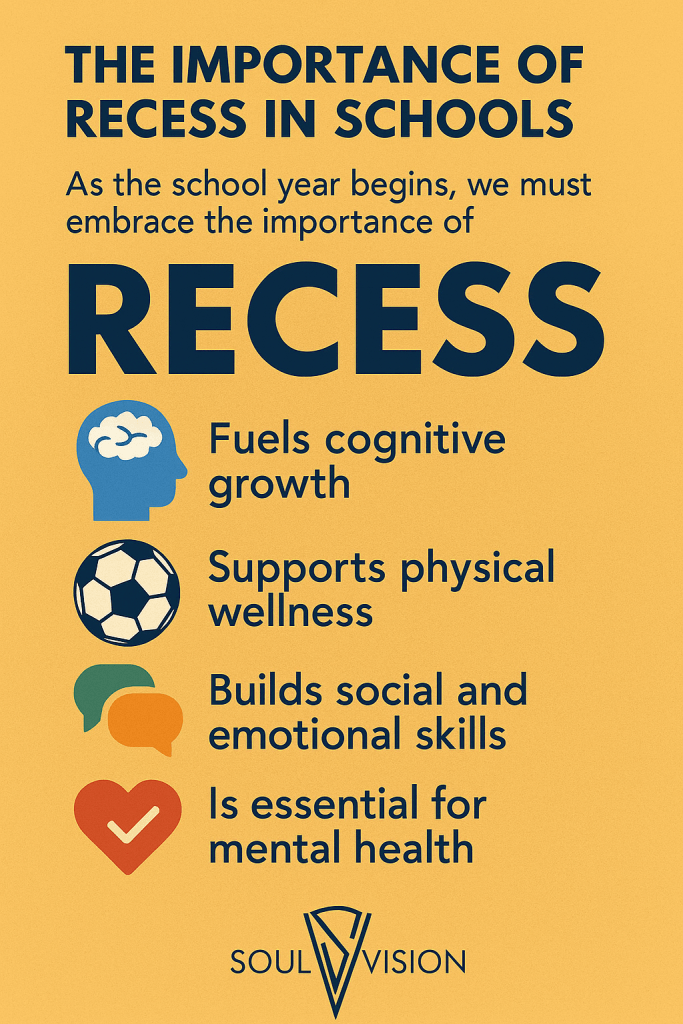
1. Recess Fuels Cognitive Development
Children’s brains are not built for nonstop academic engagement. Studies show that unstructured play and physical activity significantly improve focus, memory retention, and problem-solving skills. After recess, students return to the classroom more alert, ready to engage, and better equipped to absorb new material. Recess isn’t stealing time from learning — it’s enhancing it.
2. Physical Health and Wellness
Recess provides one of the few guaranteed opportunities in a school day for students to move their bodies freely. With rising concerns about childhood obesity and sedentary lifestyles, recess offers:
Increased daily physical activity Improved cardiovascular health Development of motor skills and coordination
Beyond the physical benefits, movement also reduces stress hormones and boosts endorphins, supporting overall mental health.
3. Building Social and Emotional Skills
Recess is where children learn some of life’s most important lessons. In these unstructured spaces, students:
Negotiate rules and resolve conflicts Build empathy and cooperation Practice leadership and teamwork
These skills are as vital as any academic standard. By protecting recess, we’re also protecting opportunities for students to develop emotional intelligence and resilience.
4. Supporting Mental Health
For many students, recess serves as a mental reset — a chance to breathe, reflect, and restore emotional balance. Especially in a world where anxiety and depression among young people are on the rise, schools must prioritize spaces where joy and play are part of the day.
5. Equity and Access Matter
In some schools, recess is withheld as a form of punishment or reduced in favor of more academic time. But removing recess disproportionately impacts students who already face inequities outside the classroom. Recess must be protected for all children, ensuring that every student, regardless of background, has time to recharge and thrive.
A Call to Action
Recess is not an “extra.” It is a vital component of whole-child education. If we are serious about preparing students to succeed academically, socially, and emotionally, we must make recess a non-negotiable part of every school day.
As educators, leaders, and advocates, we must challenge policies and practices that diminish the value of play and fight for systems that understand that learning and wellness are intertwined.
 Soul Vision Views
Leave a comment